Before You Regret It
Predicting Problematic Phone Sessions with In-the-Wild Wearable Data
Abstract
A 7-day in-the-wild study predicting problematic phone sessions from passive smartphone logs, low-cost smartwatch physiology, and session-level surveys.
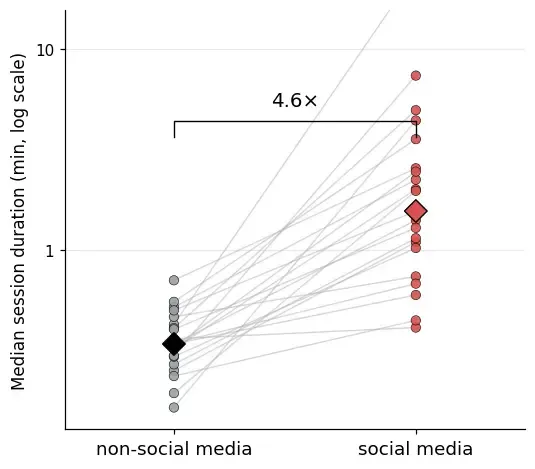
Users often feel regret after using social media, making regret a more ecologically valid target than screen time1 for understanding when phone use becomes problematic. Existing self-monitoring tools cannot anticipate regret before it occurs, and prior physiological work on social media use has been confined to the lab with research-grade sensors and curated content, leaving the question of in-the-wild prediction open.
We deployed a 7-day in-the-wild experience sampling study2 with 21 participants, combining passive smartphone logging, a low-cost consumer smartwatch (Bangle.js 2, $80), session-level surveys (1,445 sessions), and exit interviews to investigate when and why social media sessions become regretful, and whether regret can be anticipated before a session begins.

Findings
Three findings stand out. First, the gap between intended and actual use predicts regret far more strongly than session duration itself — duration’s apparent effect collapses once intention is modeled3. Second, regret is amplified when a session displaces a valued alternative, particularly at night and following productivity-app use. Third, pre-session contextual features generalize across participants while physiological signals add person-specific lift, pointing toward a two-layer architecture for just-in-time adaptive interventions4.


Acknowledgements
This work was supported by the HPI × MIT Morningside Academy for Design Grant. We thank the 21 participants for tolerating a week of session-level surveys without selecting their phone for them, the MIT Committee on the Use of Humans as Experimental Subjects for protocol review, and our colleagues at the Fluid Interfaces group and the Hasso Plattner Institute for repeated rounds of feedback on the study design and the regret operationalization. Special thanks to the Bangle.js 2 community for keeping a hackable open-source smartwatch alive — without it the physiology arm of this study would not have been feasible.
Research Groups
- Fluid Interfaces, MIT Media Lab
- Media Lab Research Theme: Connected Mind + Body
- Hasso Plattner Institute
Gallery

Footnotes
-
Screen time is what most operating-system dashboards and prior HCI literature optimize for, but two hours of intentional video calling with family and two hours of doomscrolling produce identical screen-time readings. Regret captures the user’s post-hoc evaluation and is far less confounded with content type and intention. ↩
-
Experience sampling (ESM) interleaves brief, in-the-moment surveys throughout the day to capture momentary states before they decay into reconstructed memory. We constrained surveys to immediately follow phone sessions so that participants rated specific sessions rather than aggregate impressions. ↩
-
This is a cautionary point for screen-time research more broadly: studies that report a relationship between duration and wellbeing without controlling for intention may be measuring intention all along. The same hour-long session is innocuous when planned and regretful when unplanned. ↩
-
Nahum-Shani, I., Smith, S.N., Spring, B.J., Collins, L.M., Witkiewitz, K., Tewari, A., & Murphy, S.A. (2018). Just-in-Time Adaptive Interventions (JITAIs) in mobile health: Key components and design principles for ongoing health behavior support. Annals of Behavioral Medicine, 52(6), 446–462. ↩