Double Horizon
Between Reality and Fantasy
An interactive installation exploring dual perspectives and spatial perception at Amanohashidate.
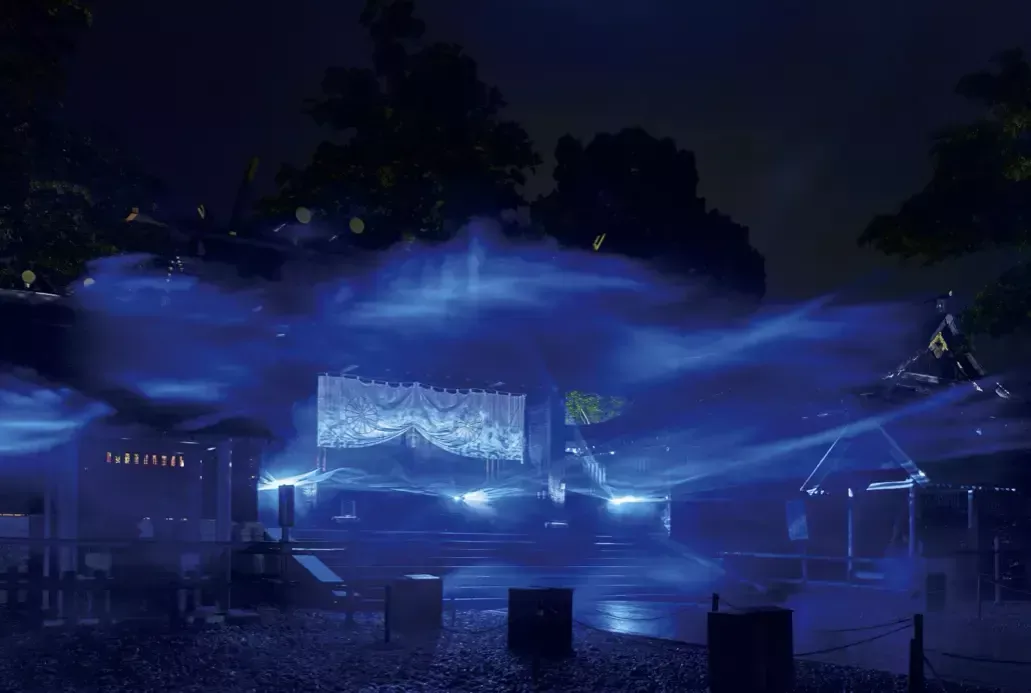
“Double Horizon” is an interactive installation artwork presented by media artist Tatsuya Saito that explores the original meaning of Amanohashidate, one of Japan’s “Three Most Scenic Views.”
About the Project
In Japanese language, both the sea and the sky are called “Ama.” Why are these two different elements expressed with the same sound? Saito’s installation work suggests a space that—derived from the origin of Amanohashidate—looks beyond the horizon.
The work was exhibited at the approach to Motoise Kono Shrine, a sacred place that inherently occupies a liminal margin between two worlds. Saito made use of looming fog and projections to create an illusion of a three-dimensional sea surface, or flowing clouds.
The Concept: Ama
The installation probes the linguistic and conceptual duality of “Ama” in Japanese:
- 天: The sky above
- 海: The sea below
By exploring why these two fundamentally different elements share the same sound, the work invites viewers to contemplate boundaries, transitions, and the spaces between worlds.
Installation at Motoise Kono Shrine
The shrine, located north of Amanohashidate, is historically significant as the “former Ise” (Motoise) where the sun goddess Amaterasu and the goddess Toyo-uke Daijin were enshrined before being moved to Ise-jingu Shrine. The site’s sacred nature—existing between two worlds—made it the perfect setting for an artwork exploring dual perspectives.
Gallery
