SonoPatch
Wearable Sonophoresis for On-Demand Physiological Modulation
Abstract
Wearable sonophoresis device using low-frequency acoustic stimulation to deliver psychoactive substances transdermally for on-demand physiological modulation.
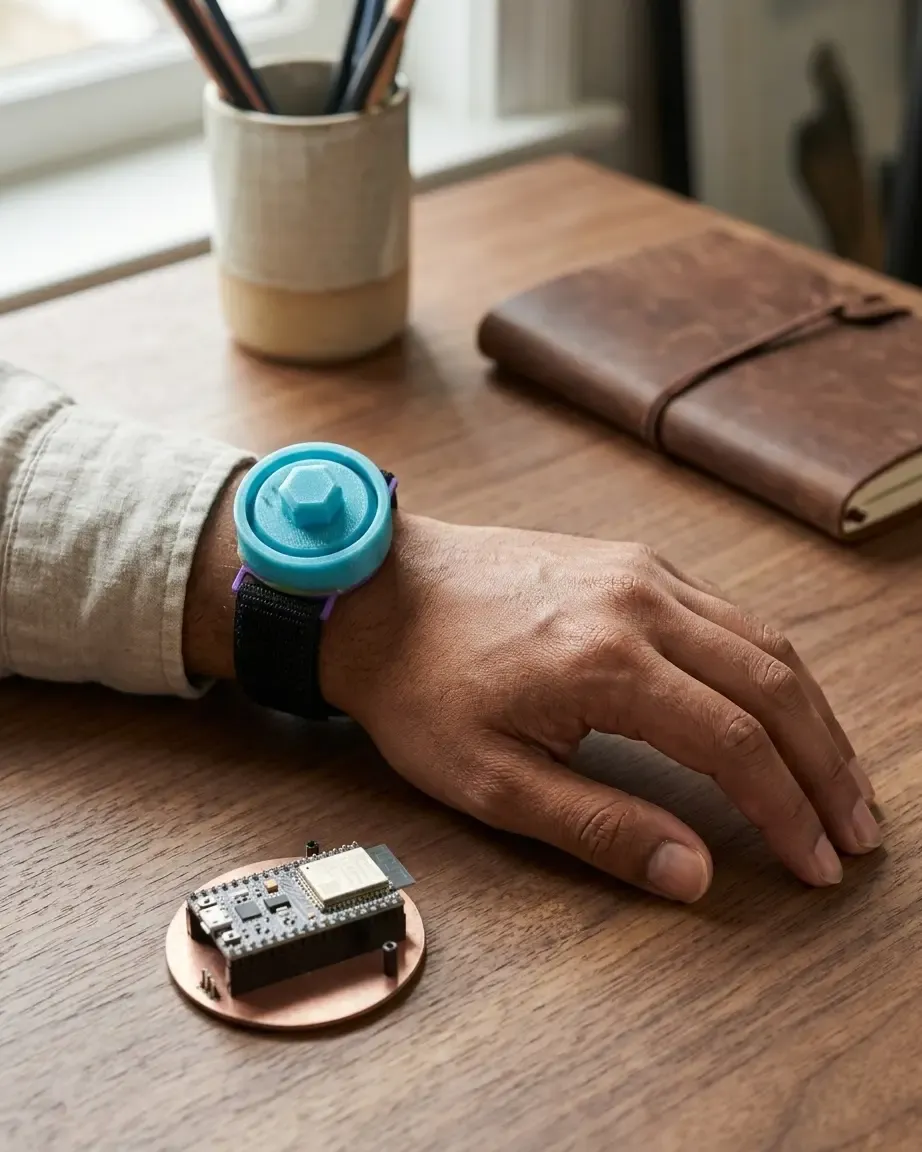
Existing interfaces modulate user experience through visual, auditory, and haptic channels, but direct physiological modulation — programmatically altering a user’s internal state — remains largely underexplored. SonoPatch is a wearable sonophoresis1 device that uses low-frequency acoustic stimulation to deliver psychoactive substances transdermally, opening a new design space for on-skin chemical interfaces in HCI.

Study Design
We evaluated SonoPatch in a double-blinded study (N=26) delivering 100 mg caffeine versus sham control, recording physiological signals during rest and a sustained attention task (SART)2. The protocol structured a baseline phase, a Device ON phase covering two SART rounds, and a Device OFF recovery phase, with dose epochs sampled around the peak delivery window.

Results
The planned comparison for heart-rate standard deviation during rest was significant (HR SD p=0.025, d=1.48), with the caffeine group showing suppressed HR SD consistent with sympathetic activation. Mean heart rate at rest was not significant (p=0.365), but exploratory analyses during the cognitive task revealed significant cardiovascular divergence: heart rate (p=0.003) and heart-rate standard deviation (p=0.027) both moved in directions consistent with systemic caffeine delivery, with effects emerging within minutes of device activation and a sustained group effect across all task rounds (p<0.001).

Conclusions
These results provide indirect evidence that wearable sonophoresis can deliver substances to modulate user physiology, opening the design space for on-skin chemical interfaces that adapt delivery in real time to change the user’s physiological state on demand.
Acknowledgements
We thank the 26 participants who volunteered for the double-blinded sonophoresis trial, the MIT Committee on the Use of Humans as Experimental Subjects for protocol review, and the Fluid Interfaces group at the MIT Media Lab for iterative critique of the device and study design. Hardware iteration was supported by the MIT Media Lab Research Theme on Connected Mind + Body. We are grateful to Adrian Schiller for early discussions on low-frequency ultrasonic transduction.
Research Groups
- Fluid Interfaces, MIT Media Lab
- Media Lab Research Theme: Connected Mind + Body
Footnotes
-
Sonophoresis (also called phonophoresis) is the use of low-frequency ultrasound to transiently increase skin permeability, allowing molecules that would otherwise be blocked by the stratum corneum to diffuse into peripheral tissue. The mechanism is mechanical, not thermal — acoustic cavitation creates short-lived microchannels in the lipid layer. ↩
-
Robertson, I.H., Manly, T., Andrade, J., Baddeley, B.T., & Yiend, J. (1997). ‘Oops!’: Performance correlates of everyday attentional failures in traumatic brain injured and normal subjects. Neuropsychologia, 35(6), 747–758. The SART is a Go/No-Go task where infrequent No-Go targets among frequent Go trials require continuous vigilance — sensitive to subtle shifts in sustained attention. ↩