XENON
The algorithmic chimera
Algorithmic chimeras created through GAN, jacquard weaving, and computational pattern making.
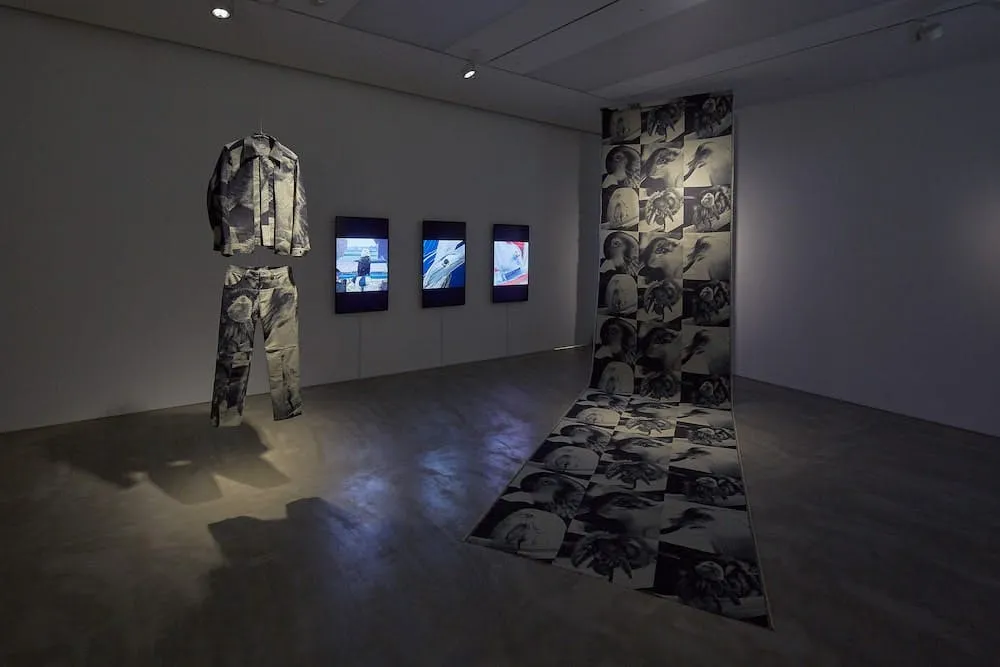
XENON is a new clothing prototype designed by exploring the fusion possibilities of artificial intelligence, art, and craftsmanship. The chimeric pattern data generated by AI is woven as a jacquard tapestry by skilled artisans, and further tailored into a geometrically shaped denim setup created by algorithms.
About the Project
This work was produced through three algorithmic processes. First, the image of the “chimera” that governs this piece was generated by training on approximately 25 million images of animals that are objects of worship worldwide or circulate as memes using a GAN (Generative Adversarial Network). Second, the data groups generated by AI were woven into jacquard textiles in collaboration with textile artisans in Okayama and Kobe. Finally, using an algorithm that can automatically generate geometric patterns from three-dimensional body data, the pieces were finished as clothing.
The work attempts to position the jacquard loom and artificial intelligence on the same timeline of computing history, while traversing between the artisan’s skilled techniques, the primitive binary operations of the jacquard machine, and AI-generated data, preserving explosive amounts of information as a medium in textiles. By accepting an excess that exceeds human knowledge and deviating from optimization, it explores the representation of the “heterogeneous algorithmic chimera” where information and life, nature and the artificial blend together.
The Algorithmic Chimera


Technical Process
Step 1: GAN Training
The chimera imagery was created by training a Generative Adversarial Network on approximately 25 million animal images from around the world. These images include animals that are objects of worship or circulated as cultural memes, creating a dataset that reflects human cultural memory and beliefs.
Step 2: Jacquard Weaving
The AI-generated pattern data was transformed into physical textile through collaboration with skilled artisans in Okayama and Kobe, Japan. The jacquard loom, an early form of binary computing, serves as a historical bridge between punch card technology and modern AI.
Step 3: Computational Pattern Making
Using algorithms that can automatically generate geometric patterns from 3D body scan data, the jacquard textiles were transformed into a complete denim setup. This process ensures precise fit while maintaining the geometric aesthetic of the digital patterns.
Fabric Details


The Design Philosophy
Rather than using artificial intelligence for future prediction or simple problem solving, the work views AI as a source of inspiration to deviate from “optimization.” The goal was to create expressions where the behavior and representation of artificially manipulated life forms emerge from vast amounts of data.
In addition, by fusing the skilled techniques of jacquard artisans with AI-generated pattern data, the project explores artistic expressions that combine craftsmanship with advanced technology. The work questions the role of AI not as a tool for efficiency, but as a collaborator that can generate excess and diversity beyond human intention.
Garment Construction


Credits
Project Lead: Kazuya Kawasaki (Synflux) Design Lead: Kotaro Sano (Synflux) Visual Programming: Ryo Yumoto Design Support: HATRA Technical Advisor: Kye Shimizu Movie Edit: Kotaro Sano (Synflux) Music: Ryo Yumoto (Synflux)
Image: Kotaro Sano (Synflux)
Advisors: Yosuke Takahashi, Takayo Iida
Collaborators: Fukle inc., Okido Weaver., Yosuke Takahashi, Takayo Iida
Gallery


